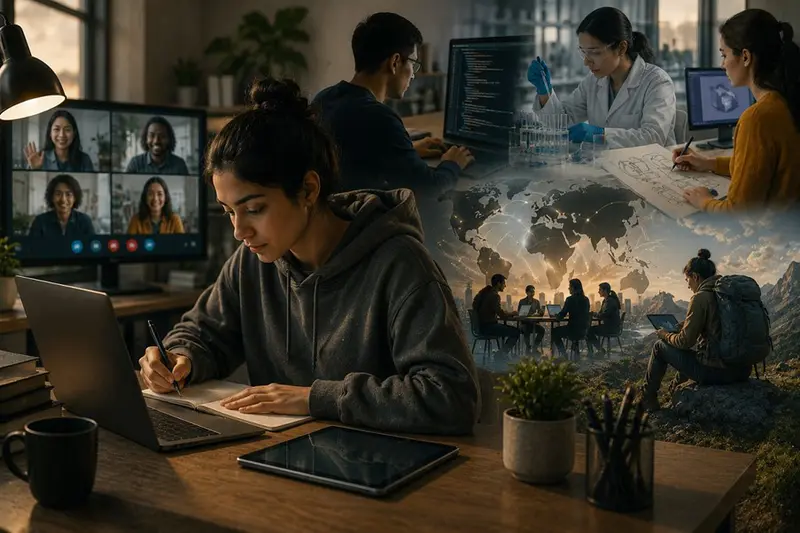
For decades, education followed a relatively predictable model.
Students studied for years, earned qualifications, entered the workforce, and gradually built careers based on knowledge acquired early in life. Degrees often represented long-term professional identity. Universities acted as primary gateways to economic opportunity. Skills evolved slowly enough for education systems to remain relatively stable across generations.
For a long time, the structure worked.
Industrial economies required specialized expertise, stable career pathways, and clearly defined professional roles. Employers valued credentials because industries themselves changed at a manageable pace. Education largely prepared individuals for careers expected to last decades.
Then the modern economy accelerated.
Technology transformed industries faster than institutions could adapt. Artificial intelligence began reshaping workflows. Automation changed labor markets. Remote work altered professional expectations. Entire industries evolved within a few years rather than generations. Skills once considered highly valuable suddenly became outdated far more quickly than before.
At the same time, something equally important happened beneath the surface.
People began changing the way they think about learning itself.
Education is no longer viewed simply as preparation for adulthood.
Increasingly, it is becoming a lifelong strategy for staying adaptable in a rapidly changing world.
This shift may become one of the most important transformations shaping the future economy over the next decade.
Because the modern workforce no longer rewards knowledge alone.
It increasingly rewards the ability to continue learning long after formal education ends.
Historically, education systems were built around stability. Schools and universities organized learning into structured timelines. Students progressed through standardized stages designed to prepare them for relatively predictable professional futures.
Today, however, predictability itself has become less certain.
Artificial intelligence is reshaping industries ranging from finance and healthcare to logistics, marketing, law, and manufacturing. Digital transformation continues altering how businesses operate globally. Remote and hybrid work models are redefining collaboration. Entire job categories are evolving rapidly under technological pressure.
As a result, the relationship between education and employment is changing fundamentally.
For many professionals, learning no longer ends with graduation.
It barely begins there.
Modern workers increasingly understand that career stability may depend less on a single qualification and more on continuous adaptation over time.
This realization is influencing students, employers, universities, and governments alike.
Increasingly, people are asking different questions about education.
Not simply:
“What career does this degree lead to?”
But:
“How adaptable will these skills remain over the next decade?”
That distinction matters enormously.
According to the World Economic Forum’s Future of Jobs Report, employers increasingly prioritize analytical thinking, resilience, adaptability, and continuous learning as technological transformation reshapes global labor markets.
https://www.weforum.org/reports/the-future-of-jobs-report-2023/
This reflects a broader economic shift far beyond classrooms themselves.
The future workforce may increasingly belong not to those with the most static expertise, but to those capable of evolving alongside rapidly changing industries.
One of the most interesting changes happening quietly within education is the growing value of flexibility.
For years, educational success often followed highly structured pathways. Students pursued linear academic journeys tied closely to predefined career expectations. Professional identity became strongly connected to formal credentials.
Now many learners increasingly prioritize adaptability over rigid specialization.
This helps explain the rapid growth of:
- online learning platforms
- professional certification programs
- hybrid education models
- skills-based learning
- micro-credentials
- executive education
- career transition courses
The shift reflects changing economic realities.
Modern careers increasingly involve multiple transitions rather than single lifelong trajectories. Workers may change industries, roles, technologies, or business models several times during their professional lives.
As a result, learning itself is becoming more continuous.
This transformation is also reshaping how employers think about talent.
Historically, companies often prioritized degrees as primary indicators of capability. Formal credentials still remain enormously important across many industries. But employers increasingly recognize that adaptability, communication, emotional intelligence, and problem-solving may matter just as much as technical knowledge alone.
This is particularly important as artificial intelligence expands across professional environments.
AI is rapidly automating repetitive tasks, accelerating information processing, and transforming operational workflows. But while technology improves efficiency, it also increases the value of uniquely human capabilities.
Creativity, emotional intelligence, communication, judgment, collaboration, and strategic thinking are becoming increasingly valuable precisely because they remain difficult to automate fully.
This creates an interesting paradox.
The more technologically advanced the economy becomes, the more valuable human adaptability becomes alongside it.
According to research from McKinsey, automation and AI are expected to significantly reshape labor markets globally, increasing demand for workers capable of continuous reskilling and professional reinvention.
https://www.mckinsey.com/featured-insights/future-of-work
This shift may fundamentally change how societies define educational success.
Historically, education often emphasized knowledge accumulation. Students mastered information, memorized frameworks, and demonstrated technical understanding through standardized evaluation systems.
Today, however, information itself has become permanently accessible.
The modern challenge increasingly involves interpretation rather than access.
Professionals now operate in environments flooded with information, data, opinions, algorithms, and rapid technological change. In this context, the ability to think critically, evaluate complexity, and adapt continuously may become more important than memorizing static knowledge alone.
This does not mean traditional education is losing relevance.
Rather, its role is evolving.
Increasingly, education may function less as a finite phase of life and more as a long-term process supporting professional resilience.
This emotional dimension of learning is also becoming increasingly important.
Modern workers face significant uncertainty surrounding career stability, automation, economic change, and evolving workplace expectations. In this environment, education increasingly represents more than professional advancement.
It represents confidence.
People pursue learning not only to improve income potential, but also to reduce anxiety about becoming professionally obsolete.
This psychological shift matters enormously.
Consumers increasingly view education as a form of personal security within rapidly changing economies.
That helps explain why adult education, reskilling programs, and flexible learning ecosystems continue expanding globally.
Interestingly, some of the most successful educational models emerging today focus less on rigid institutional hierarchy and more on accessibility, flexibility, and real-world applicability.
Students increasingly value learning environments that feel:
- practical
- adaptable
- collaborative
- career-relevant
- emotionally supportive
This reflects changing expectations surrounding education itself.
For years, educational prestige often centered heavily on exclusivity and tradition. Those qualities still matter in many contexts. But modern learners increasingly prioritize outcomes tied to employability, flexibility, and long-term relevance.
Technology accelerated this transformation dramatically.
Digital learning platforms expanded access to knowledge globally. Remote education normalized online collaboration. AI-powered tools personalized learning experiences. Educational content became more accessible outside traditional institutions.
Operationally, these changes improved flexibility enormously.
But they also introduced new questions.
How do people evaluate educational quality in digital environments?
What role should universities play in AI-driven economies?
How should societies balance technical skills with human development?
Will lifelong learning become economically accessible to everyone?
These questions are becoming increasingly important because education now sits at the center of broader economic transformation.
The future workforce will likely require continuous adaptation at unprecedented scale.
According to UNESCO, lifelong learning and digital education access are becoming central priorities globally as governments and institutions respond to rapid technological and labor market changes.
https://www.unesco.org/en/education/lifelong-learning
This shift is also influencing younger generations profoundly.
Students today grew up during periods shaped by economic volatility, technological acceleration, climate concerns, and rapidly changing career landscapes. As a result, many approach education differently than previous generations.
Increasingly, younger learners seek:
- transferable skills
- professional flexibility
- meaningful work
- adaptable career pathways
- continuous growth opportunities
Traditional definitions of professional success are evolving alongside these expectations.
In many ways, education itself is becoming less about preparing for a single career and more about preparing for continuous change.
That distinction may define the future of learning more than any single technological innovation.
The future of education will unquestionably remain technological. Artificial intelligence, virtual learning environments, predictive analytics, and digital ecosystems will continue transforming how people access and experience learning globally.
But another quieter transformation may occur alongside technological advancement.
The educational systems most likely to succeed may not simply be those delivering information fastest.
They may be the institutions helping people feel most capable of adapting confidently within rapidly changing economies.
That distinction matters enormously.
Knowledge remains valuable. Expertise remains valuable. Technical skill remains valuable.
But adaptability may become the defining professional currency of the modern era.
The global economy increasingly rewards people capable of learning continuously, thinking critically, and navigating uncertainty without becoming overwhelmed by it.
In many ways, education is rediscovering something it unintentionally overlooked during years dominated by credentials and standardization.
Learning is not simply preparation for work.
It is preparation for change.
And over the next decade, that realization may quietly reshape how societies think about careers, opportunity, and the future of human potential itself.